Thermal describes the printing method, not a universal waterproof rating. Check the face material, printed image, adhesive, and stated test conditions separately.
A label can stay attached while its image becomes hard to read, or keep its image while peeling away. A broad waterproof product title does not tell you which of those failure modes was actually tested.
Ask what must survive
| Requirement | What to verify |
|---|---|
| Brief incidental moisture | Supplier's stated resistance and a realistic application test. |
| Immersion or repeated soaking | Explicit material and adhesive suitability for that exposure. |
| Cold storage | Application conditions and later service conditions. |
| Cleaning chemicals | Named chemical compatibility, not a general water claim. |
Do not substitute one type of exposure for another. A splash trial does not establish outdoor life, chemical resistance, or indefinite immersion.
Read a real data sheet
As one example, Zebra’s PolyPro 3000D specification identifies a direct-thermal synthetic material and an adhesive, but also lists indoor use and instructs users to test water exposure in their application. A synthetic face stock is therefore not enough information to promise universal waterproof performance.
Zebra: PolyPro 3000D material specifications and test limits
For any product you are considering, request the exact stock code, printing method, recommended printer compatibility, exposure limits, and adhesive conditions. Similar product names may refer to different materials or constructions.
Run a sample test without risking shipments
- Print a non-customer sample with small text, a test code, and a date. Use the printer settings intended for that stock.
- Apply it to the same package material you actually use, following the specified application conditions and dwell time.
- Expose the sample only to the relevant, safe real-world conditions. Keep an unexposed control beside it.
- Inspect the face, image, edges, and bond separately. Record what changed and after how long.
- Ask the supplier to interpret any failure before ordering in volume.
- Treat the result as a limited application trial, not a certified performance rating.
Choose the entire labeling system
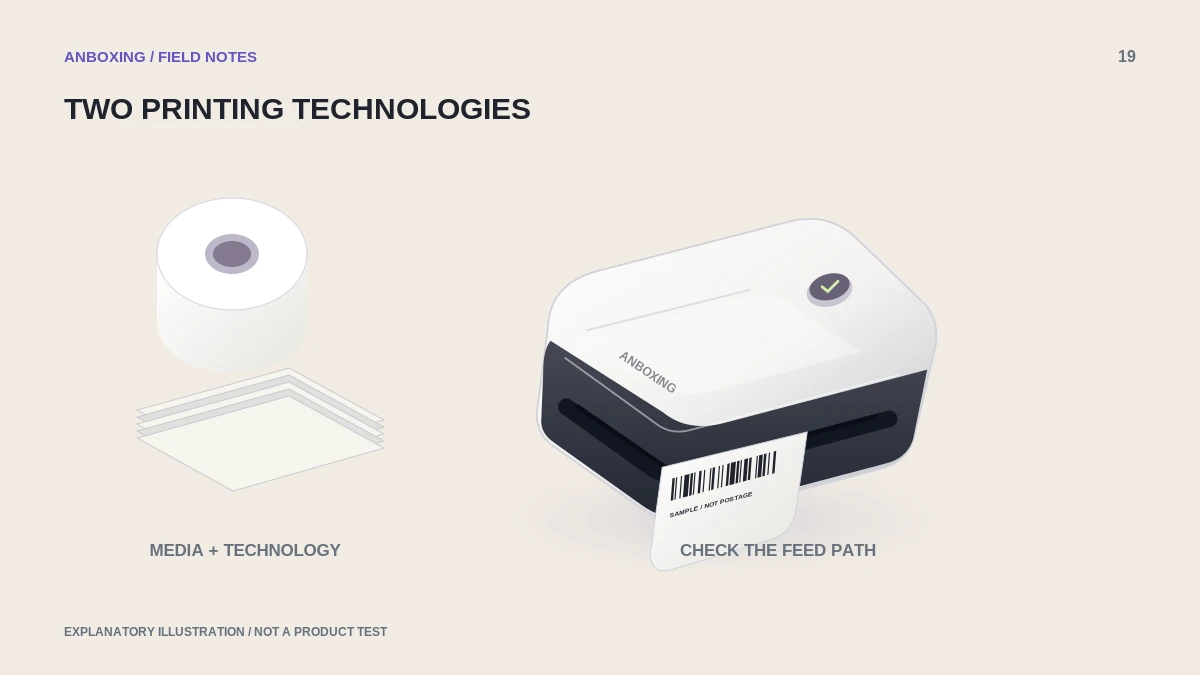
For a demanding use, the decision may involve a different label construction, adhesive, or printing method rather than merely a thicker version of the same stock. Confirm printer compatibility before switching: direct-thermal and thermal-transfer supplies are not interchangeable simply because both use the word thermal.
Avoid blanket claims in your own product listings. Describe the exact material and supported conditions, and retain the supplier’s documentation. A careful statement about suitability is more useful than a promise that every printed label is waterproof.
Common questions
Is every polypropylene thermal label waterproof?
No. Read the complete specification and test the intended application.
Does water resistance also mean alcohol resistance?
No. Water and solvent compatibility are separate requirements.
Sources & scope
Source-based editorial guide. Primary references checked September 9, 2026. Diagnostic sequences and comparisons are editorial guidance, not results of hands-on product tests. Confirm current instructions and compatibility for your exact model.