Follow the stock supplier’s storage specification and keep printed labels away from unsuitable heat, light, and chemical contact. Do not assume adding clear tape protects thermal print.
A label can leave the printer looking good and become unreadable later. That makes storage and attachment part of print quality, not an afterthought. Separate unused-stock handling from the treatment of a label already attached to a parcel.
Avoid a universal shelf-life promise
Direct-thermal material remains sensitive to its environment. Zebra describes heat, light, and abrasion as relevant limitations. The actual readable life depends on the material and conditions, so a single claim such as lasts five years is not a substitute for a supplier specification.
Record how long you actually need the label to remain readable and what it will experience. A short shipment, warehouse shelf label, and long-term equipment tag are different applications. Choose stock for the application instead of expecting one shipping roll to serve all three.
A practical unused-stock routine
- Keep stock in the storage conditions specified by its supplier.
- Retain packaging or product identifiers so the material can be traced and reordered.
- Avoid placing stock next to heaters, strong sunlight, liquids, or sources of contamination.
- Protect roll edges and fanfold stacks from crushing or distorted storage.
- Use a consistent stock-rotation system rather than mixing unknown batches.
- After moving stock from unusual conditions, follow any supplier conditioning instructions before use.
Attachment is not the same for every material
Rollo cautions against placing tape over its thermal shipping labels because contact and reflection can interfere with the result. Do not extend a paper-label attachment instruction to every thermal adhesive label. Follow the carrier, printer, and stock guidance applicable to the material you are actually using.
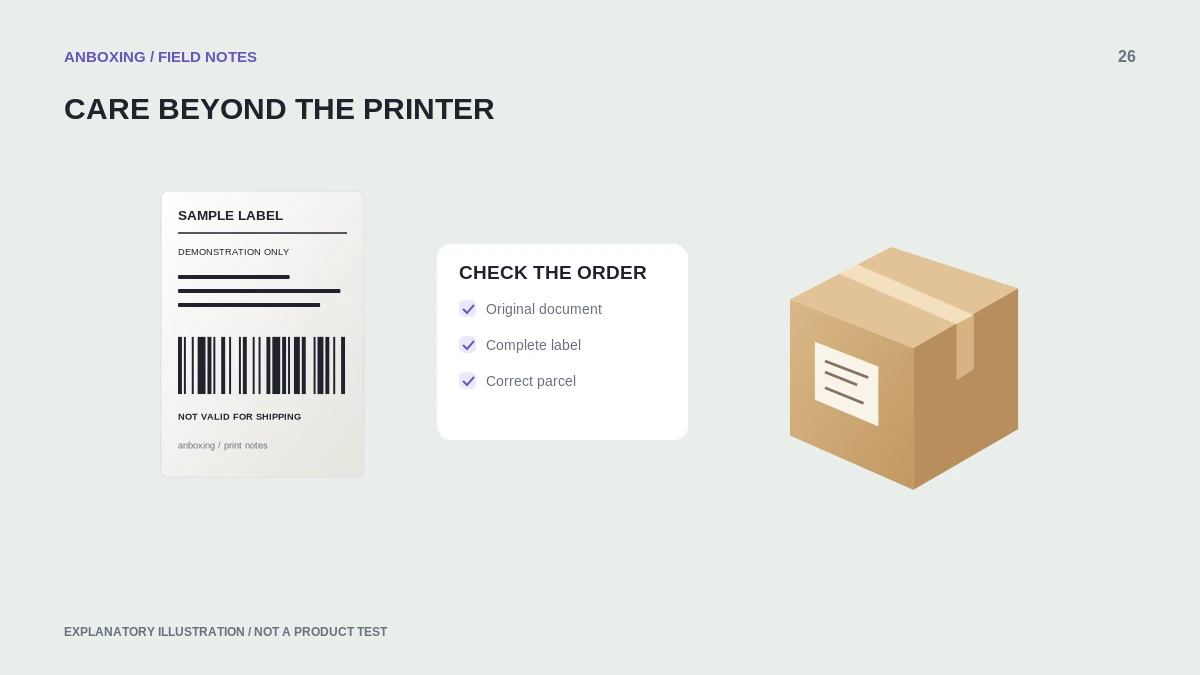
Apply the correct label smoothly to a suitable parcel surface, keeping barcodes and required information visible. Do not cover an old shipping label with a new one while leaving another readable tracking code exposed elsewhere on the parcel. Follow the carrier’s parcel-preparation requirements.
Investigate when the change happens
| Timing | What to document |
|---|---|
| Already pale at the exit | File, print settings, and current stock batch. |
| Changes after tape is applied | Attachment material and contact area. |
| Changes after storage in a hot location | Exposure history and stock specification. |
| Only one supply batch behaves differently | Supplier SKU, batch, and storage history. |
Keep a non-sensitive comparison sample under normal conditions when evaluating a supply. Describe your observation narrowly: it is a test of that sample and environment, not a proof of universal durability.
For longer-life labels, revisit the whole system
When the job requires greater durability, ask the printer and stock supplier about an appropriate technology, material, ribbon where relevant, and adhesive. Do not assume a darker print setting will solve an environmental mismatch.
A purchasing requirement should state the surface, intended life, handling, temperature exposure, moisture, and cleaning conditions. Those facts help a supplier recommend a suitable system more reliably than the request waterproof thermal labels alone.
Common questions
Should I cover a thermal shipping label with clear tape?
Follow the specific stock and carrier guidance. Rollo explicitly cautions against tape over its thermal shipping labels; tape is not a universal protective treatment.
Does thermal transfer always solve durability needs?
No automatic guarantee follows from the technology name. The complete printer, media, ribbon, adhesive, and exposure requirements still need to match.
Sources & scope
Source-based editorial guide. Official documentation checked September 6, 2026. No hands-on product testing is claimed. Interfaces and compatibility can change; use the current instructions for your exact model.
Illustrations explain a workflow or concept and are not evidence of product testing. Read the label-printer editorial policy.